
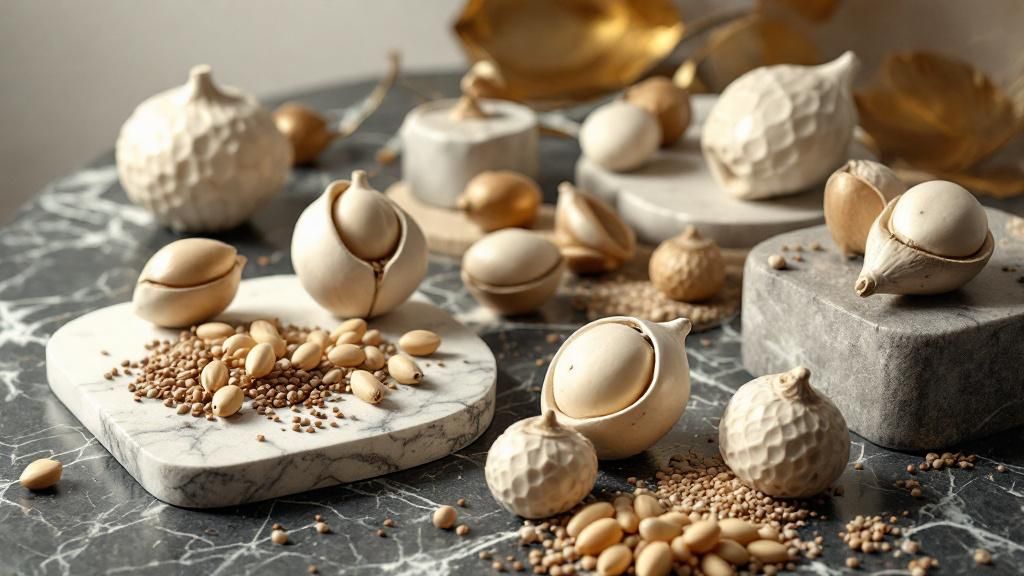
Veronica Ryan’s career survey at the Whitechapel Gallery in London presents a paradox: the Turner prize-winning artist’s decades-spanning exploration of organic forms has produced moments of authentic excellence, yet her latest work risks undermining that vision beneath what seems like merely rubbish. The Montserrat-born British artist, renowned for winning the Turner prize in 2022, has devoted years transforming seeds, pods and ordinary substances into sculptures imbued with metaphorical resonance. This comprehensive show traces her progression from early experiments in lead to current creations made of twine, bandages and plastic. Yet whilst her thematic method—using avocados, tea and mango pods to explore themes of global trade, migration and extraction—remains theoretically fascinating, the sheer accumulation of recycled detritus threatens to obscure the very ideas that give these works their power.
From Seeds to Symbolism: Ryan’s Artistic Journey
Veronica Ryan’s body of work has continually sourced ideas from the natural world, especially through seed structures and living organisms that hold stories of evolution, metamorphosis and connection. Over the course of her practice, she has demonstrated a remarkable ability to draw out rich meaning from simple natural objects, elevating them from mere objects into powerful vessels for exploring complex themes. Her work operates as a pictorial system where each seed pod, kernel or plant form becomes a representation of broader stories concerning our lived experience, cross-cultural interaction and life’s recurring patterns. This artistic sensibility has secured her standing among contemporary artists and made her a unique presence in sculptural practice.
The artist’s creative path has been defined by a sustained involvement with the materiality of transformation. Beginning with her initial explorations in lead, Ryan gradually expanded her artistic language to incorporate an increasingly diverse range of materials, from ceramic to bronze, textiles to found objects. This progression demonstrates not merely a technical advancement but a deepening commitment to investigating how conceptual depth can be embedded within form. Her Turner Prize victory in 2022 validated decades of sustained creative endeavour, honouring her impact on current sculptural discourse and her ability to create works that operate on both aesthetic and conceptual levels. The retrospective structure enables viewers to trace these changes across time, witnessing how her conceptual interests have matured and deepened.
- Seeds and pods symbolise international commerce pathways and human migration patterns
- Binding materials in string and bandages conveys restoration and recuperation processes
- Recycled plastic shows that abandoned items maintain intrinsic worth
- Ceramic cocoa pods and bronze magnolia seeds convey narratives with clarity and assurance
The Importance of Lucidity in Contemporary Sculpture
What distinguishes Ryan’s most striking works is their ability to communicate meaning with clarity and assurance. Her ceramic cocoa pods and grand-scale bronze magnolia seed require no explanation, demanding minimal interpretative gymnastics from the viewer. These pieces show that conceptual sophistication need not come wrapped in obscurity or disguised beneath accumulated found materials. When an artist has faith in their medium and their ideas sufficiently, the result is work that achieves both aesthetic beauty and intellectual resonance. The viewer encounters something that is simultaneously visually arresting and conceptually clear, permitting meaningful engagement rather than perplexed disappointment.
This lucidity proves notably significant in an artistic sphere typically concerned with ambiguity and challenge. Ryan’s finest creations establish that complexity of thought and accessibility do not have to be mutually exclusive. The narratives contained in her works—of global trade, migration, harm and recovery—develop authentically from the deliberate structures rather than being imposed upon them. When a bronze magnolia seed sits before you, its grand scale underscores the significance of these modest plant forms. The audience member understands at once why this practitioner has committed herself to seed forms and pod structures: they are vessels of genuine meaning, not just convenient containers for artistic conceits.
When Materials Tell Their Distinctive Narrative
The most successful aspects of Ryan’s exhibition are those where choice of medium seems inevitable rather than random. Her ceramic treatment for cocoa pods converts the delicate fragility of the original object into something increasingly permanent and grand, yet the selection appears organic rather than artificial. Similarly, her bronze magnolia seed achieves its potency through the inherent dignity of the form itself. These works work because the sculptor has understood that particular materials hold their distinct eloquence. Bronze holds historical resonance; ceramic conveys both delicacy and permanence. When these materials match conceptual purpose, the product is sculpture that operates on multiple registers simultaneously.
Conversely, the works that falter are those where material becomes mere vehicle for an idea that might be better expressed through other means. The wrapping of objects in bindings and wrappings, whilst intellectually coherent in its symbolism of repair and healing, occasionally obscures rather than clarifies rather than clarifies. When viewers must decode layers of abstract significance before they can appreciate the piece in formal terms, something essential has been compromised. The most compelling contemporary sculptural work enables form and concept to exist in meaningful exchange, with each enhancing the one another rather than one dominating the one another to the demands of explanation.
The Dangers of Over- Packaging Meaning
The recent works that occupy the gallery’s opening rooms—the coloured sacks dangling from wires, the stacked cardboard avocado trays, the grid of teabags—risk evolving into what the artist may not have intended: aesthetic clutter that needs wall text to justify its existence. Whilst the conceptual framework is solid, the execution at times feels like an instance of material accumulation rather than creative vision. The reference to Ruth Asawa at the recycling facility is somewhat unflattering; it suggests that the sheer volume of gathered objects has come to overwhelm the concepts they were intended to embody. When visitors find themselves reading labels to comprehend what they’re looking at, the instant visual and emotional impact has been diminished.
This embodies a genuine tension within current practice: the problem of making intellectually rigorous work that continues to be aesthetically engaging without pedagogical support. Ryan’s prior works, particularly those made from bronze and ceramic, reveal that she demonstrates the sculptural intelligence to accomplish this equilibrium. The question that lingers is whether the recent turn towards collected found objects constitutes real artistic progression or a retreat into the familiar gestures of institutional critique that have grown almost formulaic. The kindest interpretation is that this survey captures an artist undergoing change, investigating new territories whilst at times losing touch with the lucidity that established her earlier work so compelling.
Modernism Reexamined Through Caribbean Outlooks
What sets apart Ryan’s practice from the countless artists who have mined found materials for conceptual fodder is her distinctly Caribbean viewpoint on modernism itself. Born in Montserrat, she brings to the Western sculptural tradition a sensibility shaped by migration, displacement and the legacies of colonialism. Her use of commonplace items—avocado trays, tea, mango pods—speaks to the movement of commodities and peoples across imperial trade routes, turning what might otherwise be mere recycling into a critical examination of global systems of extraction and consumption. This sense of history elevates her work beyond aesthetic experimentation into something more politically significant.
The retrospective format enables viewers to follow how this viewpoint has deepened and evolved across decades of practice. Early works in lead, ostensibly non-representational, acquire fresh significance when examined in relation to Caribbean artistic tradition and postcolonial theory. Ryan is not merely experimenting with materials; she is remaking the visual language of modernism itself, insisting that artistic expressions originating in the Global South demonstrate equal validity and intellectual rigour as those created in the established centres of the art world. This reclamation of modernist language from a marginalised position represents one of the exhibition’s most significant achievements, even when the formal execution occasionally falters.
- Commercial pathways and colonial histories woven into ordinary products we use daily
- Healing and repair as symbolic representations for post-imperial renewal and resilience
- Modernist abstraction reimagined through Caribbean and diasporic viewpoints
Upstairs Versus Downstairs: A Historical Contradiction
The spatial arrangement of the Whitechapel exhibition establishes an inadvertent metaphor for the strengths and weaknesses of Ryan’s practice. Downstairs, where visitors encounter the recent pieces first, the gallery evokes a notably elaborate recycling centre. Coloured sacks hang uncertainly from wires, laden by plastic bottles and seed pods in arrangements that feel simultaneously deliberate and chaotic. This section of the show, whilst conceptually rich, frequently obscures rather than clarifies its own meaning beneath layers of material accumulation. The sheer visual density can overwhelm the very ideas the artist is seeking to convey.
Upstairs, by contrast, the prior works capture focus with a distinctness that the latest works seem to have abandoned. Bronze magnolia seeds and ceramic cocoa pods sit with commanding assurance, their symbolic meaning legible without necessitating substantial analytical effort from the viewer. This physical separation between floors becomes a telling commentary on artistic progression—not always linear, not always progressive. The retrospective structure, designed to honour a creative journey, instead reveals a notable paradox: the most acclaimed recent output obscures the creative and conceptual accomplishments that earned her the Turner Prize in the first place.
The Earlier Pieces That Strike a Chord
The sculptures made of lead in Ryan’s prior investigations possess a sculptural assurance that has waned in recent years. These works demonstrate a command of form and judicious material handling, allowing symbolic content to develop inherently from the object itself rather than being imposed upon it. The precise geometry and weighted materiality of these pieces speak to a sustained dialogue with the modernist canon, yet mediated by a markedly Caribbean sensibility. They accomplish what the contemporary work often finds difficult to achieve: a ideal equilibrium between formal innovation and intellectual clarity.
Similarly, the ceramic cocoa pods and bronze forms displayed upstairs demonstrate Ryan’s ability to reimagining ordinary items into grand declarations. Each piece conveys its message straightforwardly, without requiring the viewer to sift through overabundant material gathering or visual clutter. These works establish that restriction can be more potent than plenty, that occasionally the strongest creative declarations arise not from stacking materials atop each other but from choosing carefully the right form and permitting it to express itself with calm assurance.
Restoration Through Reformation and Remaking
At the centre of Ryan’s practice lies a profound involvement with transformation and renewal. When she binds objects in string and bandages, she is not merely employing ornamental methods—she is expressing a visual vocabulary of mending and recovery. This act of wrapping speaks to mending what has been damaged, whether material or symbolic, and to the potential of regeneration through careful, deliberate action. The bandages become symbols for care itself, indicating that even worn or abandoned things warrant care and renewal. This theoretical approach elevates her work past mere material recycling, positioning it instead as a meditation on resilience and the capacity for objects—and by extension, communities and individuals—to be reconstructed and reassessed.
The symbolism goes deeper into Ryan’s engagement with global systems of resource extraction and consumer demand. By repurposing materials connected to international trade—avocado trays, mango seed pods, cocoa husks—she develops narratives about the exploitation and journeys that connect distant places and peoples. These materials contain layered histories of labour and displacement, and by reconstructing them into new sculptures, Ryan performs an act of reclamation. She converts the detritus of commerce into objects of contemplation, asking viewers to perceive the human stories contained within everyday consumption. It is a powerful conceptual gesture, though one that threatens to be lost by the very proliferation of materials through which it tries to express.
